
Can Dating Apps Detect AI Photos? Avoid Bans [2026]
 David
David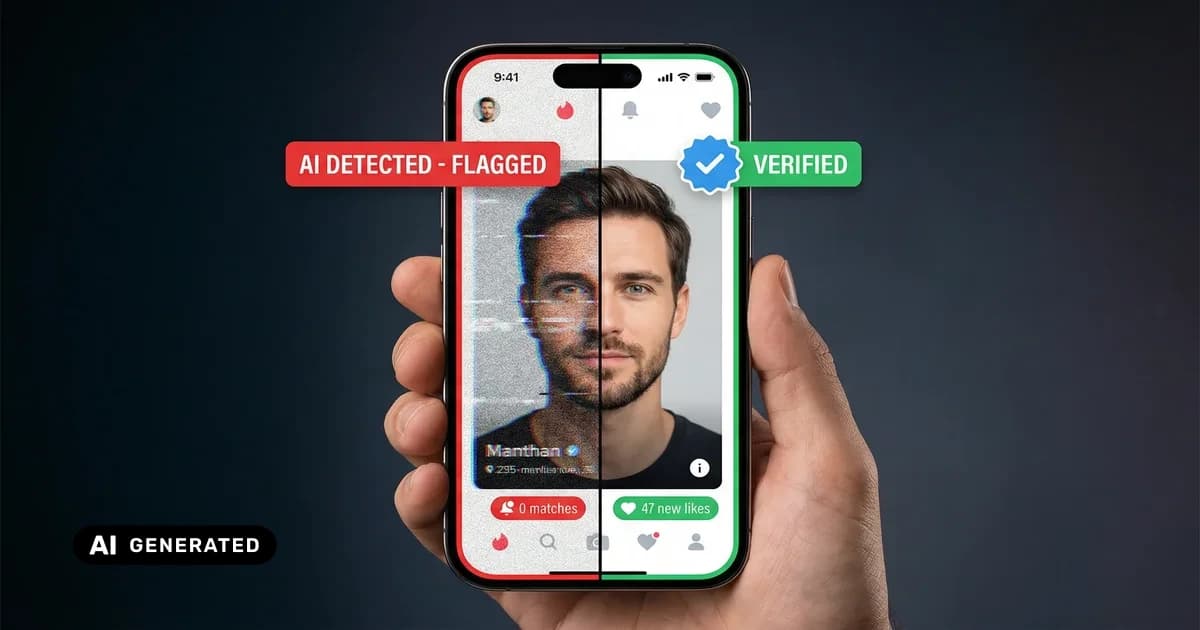
Most AI dating photos get detected because of what's happening underneath the surface. To your eyes, an AI photo might look identical to a real one. But at the pixel level, AI generated images have different patterns than photos taken with a real camera. Dating apps scan for exactly these differences.
Bumble's "Deception Detector" blocks 95% of fake accounts. And 75% of UK dating app users report they've spotted AI generated profiles, according to February 2025 research from Censuswide.
The photos look fine to humans. The algorithms see something completely different.
Key Takeaways
- Dating apps use AI detection systems that analyze pixel patterns, not visual appearance
- Photos can look perfectly real to humans but register as AI-generated at the data level
- Most AI tools get flagged because they only optimize visuals, ignoring underlying pixel signatures
- GetMatches photos pass detection tests (0% AI detected) by matching real photography at the pixel level
- Test photos at decopy.ai before uploading—anything above 10-15% AI detected is risky
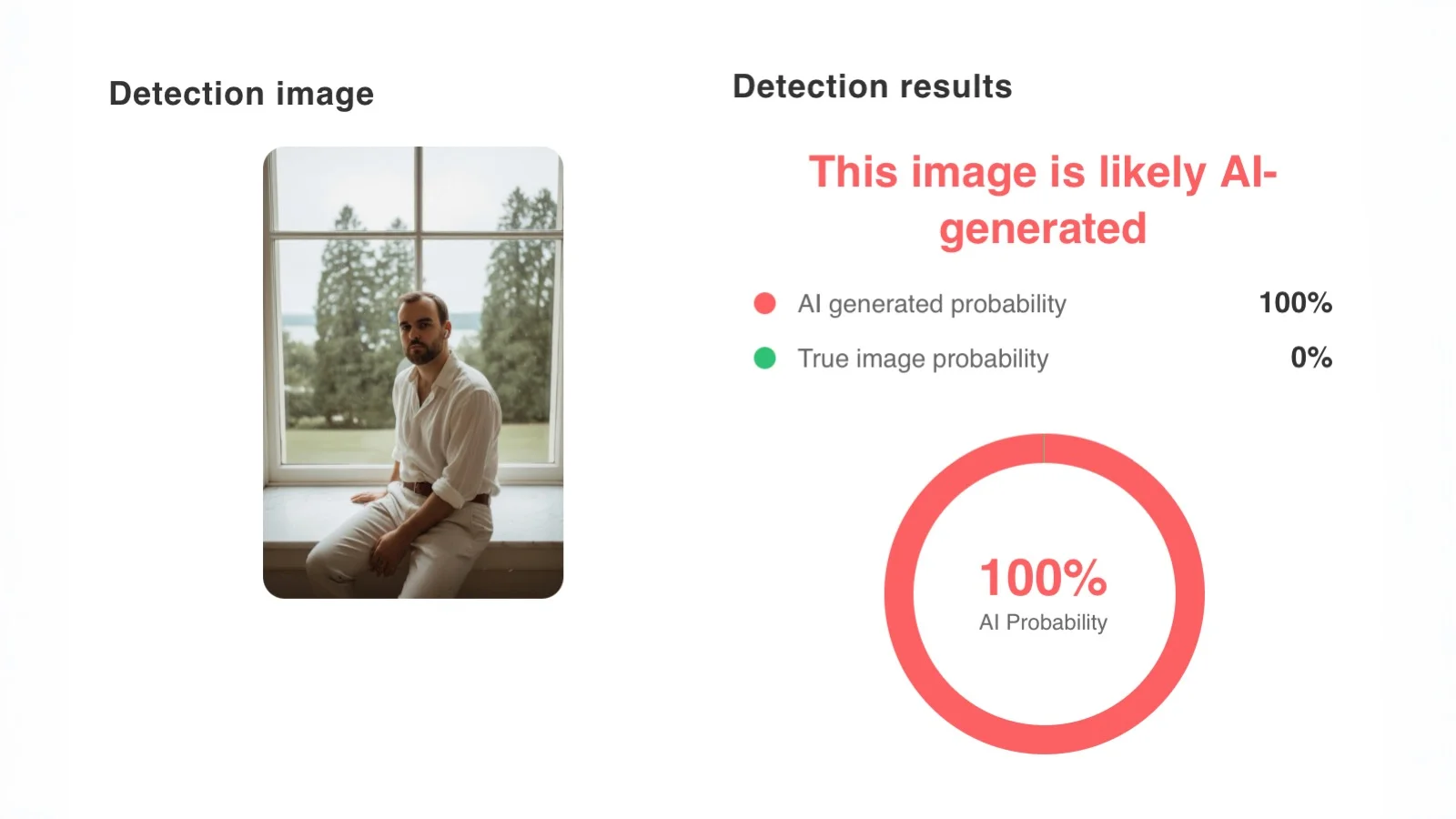
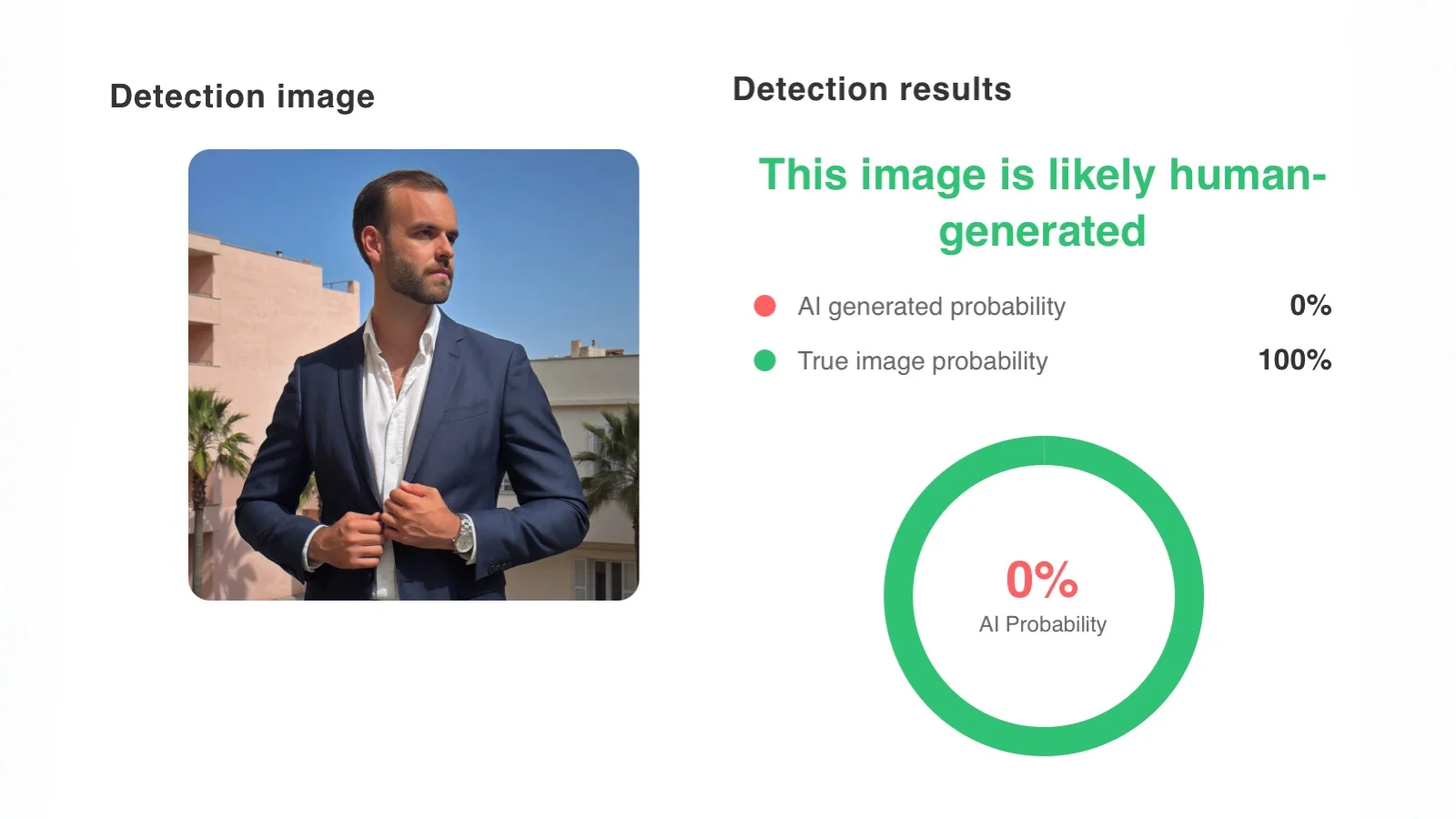
GetMatches photos pass AI detection tests. Remini photos don't. We tested both services using the same detection tools dating apps use. Remini came back 100% AI detected. GetMatches came back 0% AI detected because our photos match real photography at the pixel level. Screenshots of both tests are below.
What Detection Systems Actually See
Tinder licenses Amazon's AWS image recognition technology. Bumble and Hinge run proprietary detection models. These systems don't judge whether a photo "looks good." They analyze the underlying pixel data for patterns that betray AI generation.
Pixel noise signatures. Real cameras produce specific sensor noise based on hardware characteristics. AI generators create mathematically predictable noise patterns that look identical to humans but register as synthetic to detection algorithms.
Texture generation patterns. When AI creates skin texture, hair, or fabric, it uses computational methods that leave fingerprints in the pixel data. Your eyes see realistic skin. The algorithm sees repeating mathematical patterns.
Compression and metadata structures. Real smartphone photos have specific JPEG compression artifacts and embedded metadata (camera model, GPS, timestamps). AI outputs have different underlying structures even when the visible image looks authentic.
Google's SynthID watermarks AI-generated content at the pixel level. These invisible markers are embedded in the image data itself. Your photo looks normal. Detection systems read it like a barcode.
Your photos are the problem. We fix that.
Upload a few selfies. Get natural, phone-style photos that actually look like you — ready in about 2 minutes.
Get Started FreeNo credit card · Free to start
Generic AI Tools vs. Detection-Proof Photos
Most AI photo services optimize for how images look to human eyes. They ignore what's happening at the pixel level, which is exactly what detection systems analyze.
| Generic AI Tools | GetMatches.ai | |
|---|---|---|
| Generation time | Seconds to minutes | Minutes |
| Model type | Generic, one-size-fits-all | Personalized to YOUR features |
| Pixel patterns | Synthetic AI signatures | Matches natural photography |
| Metadata | Missing or obviously fake | Structured like real smartphone photos |
| Detection result | Flagged as AI generated | 0% AI detected |
This is why photos from Remini, generic AI enhancers, and fast generation tools get caught. The visible output looks improved. The underlying data still screams "AI generated."
Proof: Detection Test Results
I tested this using Decopy.ai's AI Image Detector, which is trained on over 10 million images to identify AI generation from tools like Midjourney, Stable Diffusion, and DALL-E.
I compared a photo generated with Remini, one of the most popular AI photo apps, to one of our GetMatches photos. Both look realistic to the human eye. The detection results tell a different story.
Remini — Detected as AI
GetMatches photo — 0% AI detected
How GetMatches Creates Detection-Proof Photos
GetMatches uses advanced AI to generate photos that capture your specific features with pixel-level accuracy. This is what makes you look like you: your real skin texture, how light interacts with your face, the subtle details that make photos authentic. If you want profile shots like this, you can make AI dating photos without booking a studio session.
But we go further. Our proprietary process ensures the pixel-level output matches exactly how natural smartphone photos look. The noise patterns, compression artifacts, color profiles, metadata structures. Everything detection systems analyze matches what they'd expect from a real iPhone camera.
The result isn't just a photo that looks real to humans. It's a photo that registers as real to AI detectors because at the pixel level, it's indistinguishable from natural photography.
This is why GetMatches is currently the only AI photo service producing photos that pass detection tests. Other services optimize for how photos look. We optimize for how photos register at the pixel level.
“Detection systems don't see what you see. When I engineer photos for dating profiles, I'm not just thinking about how the image looks — I'm thinking about the pixel-level noise signature, the compression artifacts, and whether the metadata structure matches what a real camera would produce. Most AI tools only solve the first problem and ignore the rest.”
Test Your Photos Before Uploading
Before adding photos to your dating profile, check them at decopy.ai/ai-image-detector.
Anything scoring above 10-15% AI detected is risky. The photo might look perfectly fine to you. The algorithm sees something different underneath.
Frequently Asked Questions
Photographically realistic dating photos designed to look like real phone shots — not polished studio output.
AI dating photos built to look natural3 free photos · No credit card
Written by David
Over a decade in the dating industry, portrait photographer, and machine learning engineer. For years I barely got any matches on dating apps, so I went deep — studied the science, asked women what actually works, ran experiments on my own profile. When I realized AI could generate the exact photos I knew I needed, I built GetMatches. I lived the problem, so I built the solution.
Want more tips like these?
Join the men getting weekly dating app strategies. Free, no spam.
Unsubscribe anytime. Never spam.