
No Matches on Tinder? 6 Photo Fixes That Actually Work [2026]
 David
David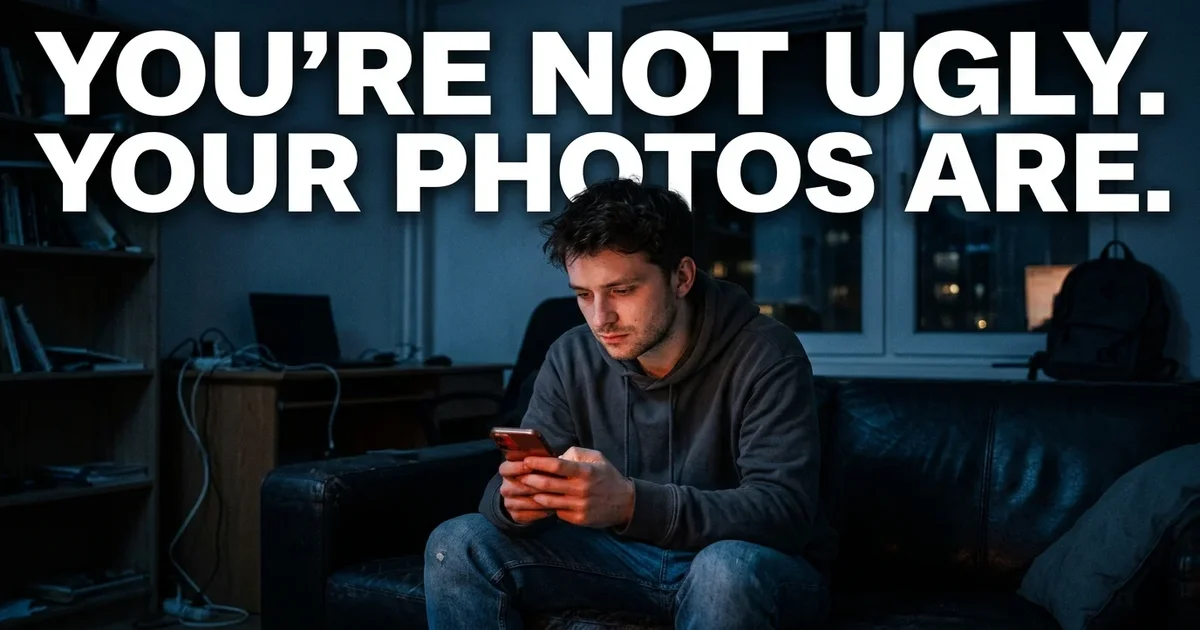
No matches on Tinder? Your photos are the problem. Not your face, not your height, not your bio.A University of Amsterdam study analyzing 5,340 real swiping decisions found that improving your photo attractiveness by one standard deviation boosts your match rate from 25% to 43% — an 18 percentage point jump. Improving your bio by the same amount? About 2%. That's the difference between invisible and actually getting dates.
This guide covers 6 specific photo fixes that work. Not generic advice like "smile more"—actual changes with measurable impact.
Free instant review: photo grades, bio score, top-3 fix list. Specific, brutal, actionable.
Find out why your Tinder profile isn't getting matches100% free · No credit card · 60 seconds
Key Takeaways
- Photos drive the vast majority of swipe decisions — bios are secondary
- A small group of male profiles receive the majority of female likes on Tinder
- Bathroom selfies and gym mirror shots actively hurt your matches
- Lighting quality is one of the highest-leverage changes you can make
- Photos taken by others outperform selfies due to social proof signals
Why You're Getting No Matches on Tinder (The Real Reason)
Most guys blame the wrong things. They think it's their height. Their job. Their face. They wonder if Tinder is rigged against average-looking men.
It's not. It's their photos.
Research and data analyses of Tinder behavior consistently show that female right-swipes are heavily concentrated on a small percentage of male profiles. That gap sounds genetic. It isn't. It's presentation. The same guy with mediocre photos and excellent photos is treated like an entirely different person.
We form first impressions in under 100 milliseconds—faster than you can blink. On Tinder, she's making that judgment while her thumb is already mid-swipe. Your bio never enters the picture. Your personality never gets a chance. It lives or dies on that first image.
| Profile Element | Impact on Match Rate |
|---|---|
| Photo attractiveness improvement (+1 SD) | +18 percentage points (25% → 43% match rate) |
| Bio quality improvement (+1 SD) | ~+2 percentage points |
| Premium subscription | No improvement to match rate |
If you're getting no matches on Tinder, statistically, your photos are the issue 90% of the time. Here are 6 specific fixes.
No matches on Tinder? Your photos are the problem.
Our free AI review scores your photos, spots weak points, and tells you exactly what to fix — in under 30 seconds.
Get Your Free Profile ReviewFix #1: Replace Your Lead Photo
Your lead photo does most of the work. Most guys lead with their worst one.
The most common lead photos men use: bathroom selfies, gym mirror shots, sunglasses where you can't see their eyes, group photos where she has to guess which one you are, and dark blurry photos from 4 years ago.
All of these are automatic left-swipes.
| Lead Photo Type | Effect |
|---|---|
| Bathroom selfie | Signals no friends, low effort |
| Sunglasses covering eyes | She can't connect — left swipe |
| Group photo as lead | Confusing — she won't work to find you |
| Solo, clear face, natural light | Gets evaluated properly |
Your lead photo should: show your face clearly, include your eyes (eye contact signals confidence), have good natural lighting, and be taken by someone else. That last part matters more than most guys realize.
Fix #2: Get Out of Fluorescent Light
Lighting is the single highest-leverage fix in photography. Bad lighting makes attractive men look average. Good lighting makes average men look attractive.
Fluorescent indoor light flattens features, creates unflattering shadows under eyes, and drains skin tone. That's what most gym selfies and bathroom photos are taken in.
Natural light from a window—or better, the golden hour just after sunrise or before sunset—creates flattering shadows, natural warmth, and texture that makes photos look professional without effort.
Try this once: take your normal selfie in your bathroom. Then go outside on an overcast day (overcast light is even and flattering) and take the same shot. Compare them. The difference is why lighting is the first thing any photographer changes.
Fix #3: Show a Lifestyle, Not a Face
Women aren't just evaluating how you look. They're evaluating what your life looks like.
A photo of you hiking tells her you're active and adventurous. A photo of you laughing with friends tells her you're social and fun. A photo of you at a concert tells her you're culturally engaged. A photo of you staring at a camera in your bedroom tells her nothing except that you were home alone.
Research on what women actually look for in dating photos consistently shows they respond to lifestyle context, not posed portraits. They want evidence of a life worth joining—not a headshot.
| Static Photos (Weaker) | Lifestyle Photos (Stronger) |
|---|---|
| Posed against a wall | Playing a sport or activity |
| Car selfie | Laughing with friends at an event |
| Bedroom mirror shot | Hiking trail, city, or travel |
| Formal headshot | Casual moment with genuine expression |
You don't need to manufacture a lifestyle. You just need to document the life you already have.
Fix #4: Delete the Photos That Actively Hurt You
Some photos don't just fail to help—they actively destroy attraction. These are worth removing even if it leaves you with fewer photos.
- Gym mirror selfies — signal vanity and insecurity, not fitness
- Shirtless photos indoors — reads as desperate, not confident
- Photos with your ex cropped out — she can always tell
- Holding a fish — meme at this point, don't do it
- Blurry, dark, or visually confusing photos — she won't squint to look harder
- Photos with other women where context is unclear — creates anxiety, not intrigue
Three excellent photos will outperform nine average-to-bad ones. Quality beats quantity every time.
Fix #5: Get Someone Else to Take Your Photos
Photos taken by another person consistently outperform selfies. This is partly aesthetic (better angles, distance, framing) and partly psychological.
When someone else is photographing you, it implies you have people in your life who care about you. It implies social inclusion. This is social proof—one of the most powerful psychological signals in attraction research.
Selfies, especially consistent selfies, signal the opposite. They suggest you either don't have people around you or don't trust them enough to take your photo.
If you genuinely don't have photos taken by others, that's fixable. Ask a friend to spend 20 minutes with you in good outdoor lighting. You'll end up with more usable material in one afternoon than months of bathroom mirror shots.
Wondering what's holding your profile back?
Our free AI review scores your photos, spots weak points, and tells you exactly what to fix — in under 30 seconds.
Get Your Free Profile ReviewFix #6: Show Your Genuine Expression
Forced smiles are detectable and they register as dishonest.Research by Dr. Paul Ekman on microexpressions found that genuine smiles (Duchenne smiles) involve the muscles around the eyes—forced ones don't. People unconsciously pick up on the difference.
The classic "serious face for the camera" that most men default to reads as stiff and unapproachable. Genuine laughter in photos—even if imperfect—reads as authentic, fun, and social.
The fix isn't to force a smile. It's to catch yourself in genuine moments. Have someone photograph you while you're actually doing something you enjoy. The expression takes care of itself.
“I've looked at thousands of dating profiles, and the pattern is always the same: the guys getting no matches aren't ugly — they have ugly photos. Lighting, expression, context. Fix those three things and you're a different person on the screen.”
The Bigger Picture: Why These Fixes Work
These aren't tricks. They're corrections to the most common mistakes that make normal men invisible on Tinder.
The Tinder algorithm rewards profiles with high right-swipe rates by showing them to more users. Better photos create a virtuous cycle: more swipes → better algorithm placement → even more swipes.
The inverse is also true. If you're getting very few matches right now, your profile is likely being shown to less engaged users, making the problem feel worse than it is. Fixing your photos breaks the cycle.
Once your photos are working, other common photo mistakes become worth addressing too. But the six fixes above will solve 80% of the problem for most guys.
If you want to understand exactly what women are looking at when they swipe, the psychology behind what women actually want in dating photos goes deeper on the science.
Frequently Asked Questions
Sources
- Witmer, J., Rosenbusch, H., & Meral, E. O. (2025). The relative importance of looks, height, job, bio, intelligence, and homophily in online dating: A conjoint analysis. Computers in Human Behavior Reports, 17, 100579. University of Amsterdam.
- Tinder user statistics and market data
- Willis, J., & Todorov, A. (2006). First impressions: Making up your mind after a 100-ms exposure to a face. Psychological Science, 17(7), 592–598.
- Ekman, P. (1992). Facial expressions of emotion: An old controversy and new findings. Philosophical Transactions of the Royal Society B, 335(1273), 63–69.
- Cialdini, R. (2006). Influence: The Psychology of Persuasion (Revised ed.). Harper Business.
Get a specific diagnosis of your profile in 60 seconds — free, no credit card.
Find out why your Tinder profile isn't getting matchesTinder, Hinge, Bumble
Written by David
Over a decade in the dating industry, portrait photographer, and machine learning engineer. For years I barely got any matches on dating apps, so I went deep — studied the science, asked women what actually works, ran experiments on my own profile. When I realized AI could generate the exact photos I knew I needed, I built GetMatches. I lived the problem, so I built the solution.
Want more tips like this?
Join guys who get weekly dating app strategies. Free, no spam.
Unsubscribe anytime. No spam, ever.